
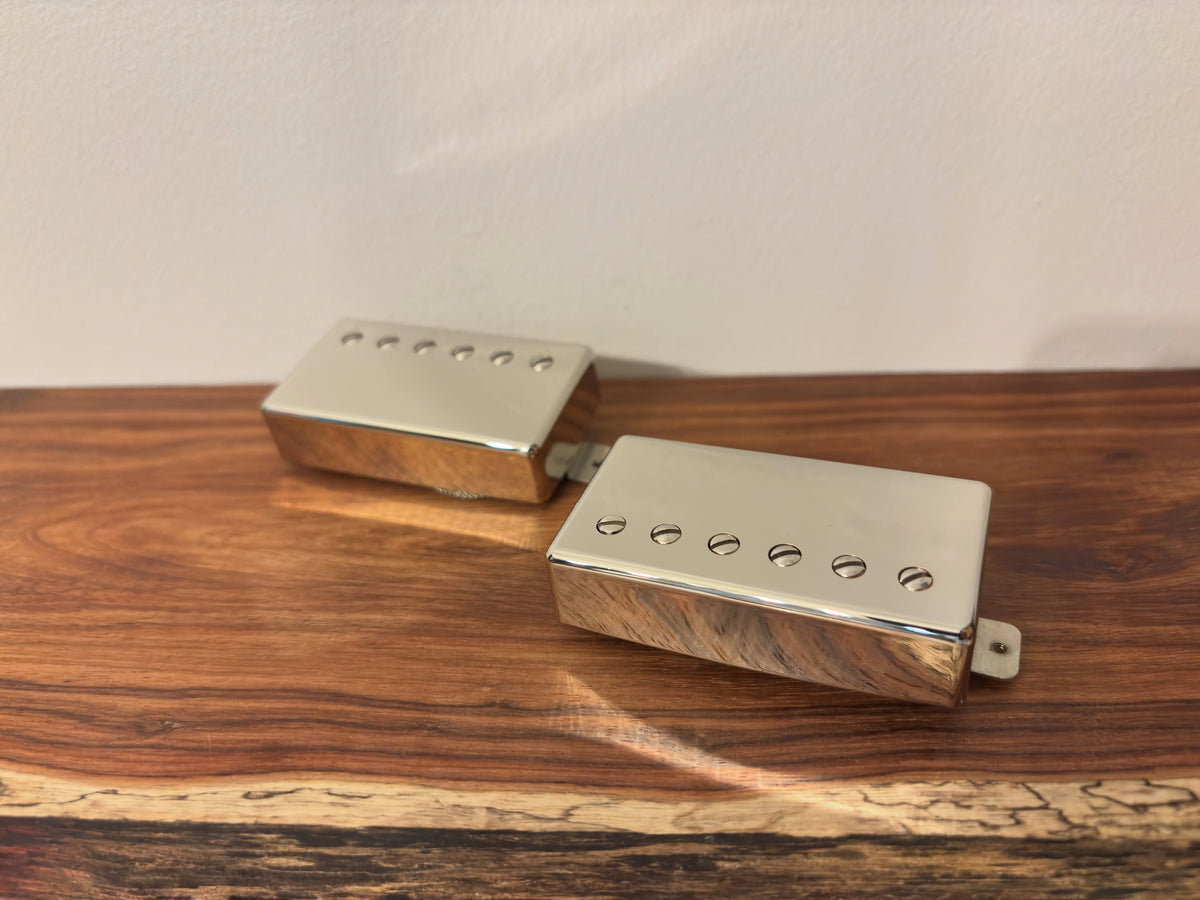
A dead original PAF is not automatically a candidate for a full rewind. It may be a corroded lead, a failed solder joint, loose cover connection, or a break near the outside of the coil that can be repaired with far less intervention. Restoring original PAF pickups is a balancing act between getting a great instrument back in service and protecting the sound, history, and collector value that made the pickup worth saving in the first place.
For players, an original PAF can be the heart of a special Les Paul, ES-335, or other early Gibson. For collectors, it is also a finite piece of guitar history. The best restoration is rarely the most dramatic one. It is the one that solves the actual problem while leaving as much original material untouched as possible.
Why Original PAF Pickups Deserve a Different Approach
PAF, short for Patent Applied For, humbuckers were built during a period when Gibson's production was far more variable than most modern pickup manufacturing. Coil turns varied. Magnet strength varied. Wire insulation, bobbin color, spacer material, and even the amount of air in the coils could vary from pickup to pickup. That inconsistency is part of why two real PAFs can measure similarly on a meter yet sound noticeably different in the same guitar.
A pickup's DC resistance tells only a small part of the story. Magnet charge, coil geometry, screw and slug balance, cover material, pot values, guitar construction, and the player's amp all matter. An original pickup with a lower reading is not necessarily weak, and one with a higher reading is not necessarily hotter in the useful sense. Before any repair begins, the pickup needs to be evaluated as a complete assembly rather than judged by one number.
There is also a simple market reality. Original windings, original magnets, original leads, and undisturbed solder joints generally carry more value than replacement parts. A perfectly competent rewind may make a pickup musically useful again, but it changes the pickup's originality. That is not a reason to avoid a rewind at all costs. It is a reason to make the decision knowingly.
Start With Diagnosis, Not a Rewind
A proper assessment begins with a careful visual inspection and a meter reading. Is the pickup fully open, intermittently working, noisy, or simply lower output than its mate? Is the braided lead intact? Are the cover solder joints original? Has moisture reached the coils? Are the bobbins cracked or warped? These details help determine whether the fault is external, mechanical, magnetic, or inside the winding itself.
An open reading does not always mean the coil is beyond repair. A wire break near the outer wrap may sometimes be found and repaired under magnification. That kind of repair can preserve nearly all of the original coil. It is delicate work, and there is no promise that every break is accessible, but it should be considered before stripping a coil down for a rewind.
Microphonic behavior needs the same patience. A lightly microphonic PAF is not automatically defective. Some players love the liveliness and harmonic edge that comes from an older, less heavily potted pickup. The question is whether it squeals uncontrollably at stage volume or merely has a little extra air around the note. Wax-potting an original PAF may cure feedback, but it can also alter its response and reduce originality. Often, the better first move is to inspect mounting, cover fit, springs, and the rest of the guitar's hardware.
Weakness can also be blamed on the wrong part. Magnets naturally lose some charge over decades, but a lower-charge magnet is not necessarily a problem. In the right guitar, that softer magnetic pull can create an open, woody attack and a sweet upper midrange. Recharging an original magnet may increase output and tighten the low end, but it can also move the pickup away from the feel that made it special. If the guitar is sounding good, leave that magnet alone.
Document Everything Before the Work Begins
Before opening the pickup, record DC resistance, magnet orientation, screw condition, lead length, bobbin colors, spacer type, baseplate markings, cover condition, and any signs of prior work. Clear photos matter. So does keeping every original part, even a damaged lead or broken cover.
This documentation protects the owner and helps the repair person make sensible choices. It also creates a useful record for a future buyer, especially if a rewind or replacement component becomes necessary.
When a Partial Repair Is the Right Call
The ideal repair preserves original coils and components whenever possible. A damaged braided lead can be replaced or carefully repaired. A loose baseplate screw can be addressed. A cover can be reattached with minimal heat. Dirty pole screws and slugs can be cleaned without turning the pickup into a shiny reproduction.
Heat is a real concern. Old coil wire and insulation can be fragile, especially after decades of temperature swings and exposure to moisture. Excessive soldering heat near the coil, aggressive chemical cleaning, or forcing corroded parts apart can create a much larger problem than the one that arrived on the bench.
If an original cover has to come off, it should be removed with a clear reason and a light touch. The cover affects capacitance and can subtly affect the top end, but its historical value may be just as important as its tonal role. Original covers, screws, springs, spacers, and leads should stay with the pickup whenever practical.
Rewinding an Original PAF: The Necessary Compromise
Sometimes a rewind is the only way to make a pickup reliable again. If the break is buried deep in the coil, the wire has deteriorated throughout the winding, or the pickup has been previously damaged beyond a stable repair, a rewind can return it to useful life. There is nothing shameful about that. A great vintage guitar should be played, not treated as a silent display piece.
Still, a rewind should be approached as conservation work, not as an excuse to build a generic vintage-style humbucker. The goal is to retain every original component that can safely remain: the baseplate, pole screws, slugs, keeper bar, magnet, bobbins, spacer, cover, and lead if it is still sound. The old coil wire should be retained and returned to the owner when possible.
The new winding should suit the pickup's original character and the guitar it lives in. That does not always mean chasing a published resistance target. One PAF may have been naturally bright and low-wind; another may have had more midrange push. The bridge and neck positions may need different treatment, and a pickup's partner matters. A bright bridge pickup can be a great match for a warm neck pickup, while two individually excellent pickups can sound unbalanced together.
A skilled winder will also consider the magnet before touching it. If the original magnet is healthy and sounds right, preserving it keeps a major piece of the pickup's voice intact. If it is damaged, badly corroded, or no longer stable, a replacement may be the sensible choice, but the original should remain with the pickup for provenance.
Restoring Original PAF Pickups for Players Versus Collectors
The right restoration depends on what the guitar needs to be. A collector-grade burst with documented parts may call for the least invasive repair possible, even if that means accepting some noise or keeping a fragile pickup out of regular gigging rotation. A well-loved 1960 ES-335 that earns its keep on stage may justify a carefully executed rewind if reliability is the priority.
For many owners, the best answer is a middle path: preserve the original pickup, make only reversible repairs where possible, and use a period-appropriate or custom replacement for regular touring. That way, the guitar can do its job without putting an irreplaceable component through every loud rehearsal, flight case, and club stage.
At Pegcity Pickups, we think the useful question is not, "Can this be made exactly new again?" It is, "What does this guitar need, and what should be preserved?" Those are not always the same thing.
Questions to Ask Before Choosing a Repair Shop
Choose someone who understands both pickup construction and vintage value. Ask whether they will diagnose the fault before recommending a rewind, whether they can preserve the original magnet and hardware, and whether they will document the work. Ask what materials they use, how they handle fragile bobbins, and whether they return removed original parts.
Be cautious with anyone promising to make a vintage pickup "better than original." A rewind can be excellent, and a repaired PAF can sound extraordinary, but it cannot restore untouched factory originality. Honest work respects that line.
The reward for taking your time is a pickup that keeps its story while getting back to what it was built to do: turn a player's hands, guitar, and amp into something that feels alive. Sometimes that means preserving every fragile detail. Sometimes it means giving a wounded old coil a careful second life. Either way, restraint is part of the craft.

Leave a comment
This site is protected by hCaptcha and the hCaptcha Privacy Policy and Terms of Service apply.