
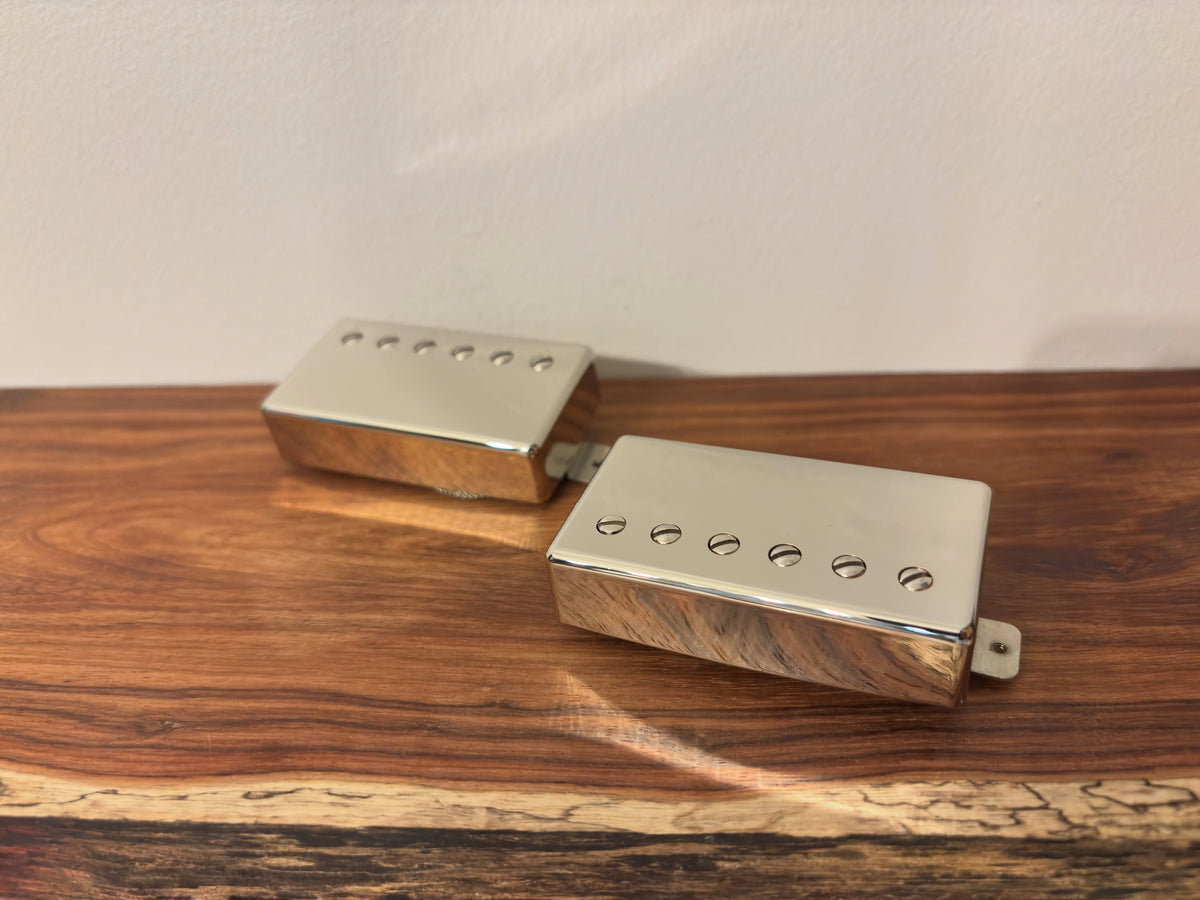
A pickup spec sheet says 7.2k, 9k, or 14k, and it is tempting to treat that number like a volume rating. Higher number, hotter pickup. Lower number, vintage output. Sometimes that shorthand points you in the right direction. Just as often, it sends a player chasing a number instead of the sound their guitar actually needs.
Pickup DC resistance explained in plain terms: it is the electrical resistance of the pickup coil's copper wire, measured with a meter in ohms. It tells us something useful about how the coil was wound, but it does not tell the complete story of output, EQ, feel, or how the pickup will behave in your particular guitar.
What DC Resistance Actually Measures
DC resistance, usually written as DCR, measures how much the coil resists a small direct current from a multimeter. Pickup makers typically express it in kilohms, abbreviated kΩ. A reading of 6.0k means 6,000 ohms of resistance. A reading of 12k means 12,000 ohms.
That number is created by the amount of copper wire in the coil and the wire's gauge. More wire generally means more resistance. Thinner wire also has more resistance per foot than thicker wire. That is where the useful part begins: a higher DCR can indicate a coil with more turns, and more turns often produce more voltage when the string moves through the magnetic field.
But “often” is doing real work in that sentence. Two coils can measure the same DCR and sound very different. One may use thinner wire with fewer turns, while another uses thicker wire with more turns. Their resistance is similar, but their inductance, resonant peak, capacitance, and magnetic relationship are not.
Why a Higher kΩ Reading Is Not Always Hotter
A pickup's perceived output is not just about resistance. It is about the whole magnetic and electrical system: coil turns, wire gauge, magnet type and charge, pole piece design, coil shape, inductance, and the distance between strings and pickup all matter.
Consider two bridge humbuckers that both read around 8k. One may use Alnico 2 magnets, a broad coil geometry, and moderate inductance for an open, sweet attack. The other may use a stronger Alnico 5 magnet, a different wire gauge, and a tighter coil shape that puts more emphasis on upper mids and immediate pick response. Same resistance neighborhood, completely different experience under your hands.
The reverse can be true, too. A 12k pickup is not automatically louder than an 8k pickup. A lower-resistance design with a strong magnet and efficient coil geometry can hit the front of an amp with plenty of authority. Meanwhile, a high-resistance coil may sound darker, thicker, or more compressed rather than dramatically louder.
This is why DCR is best treated as a clue, not a verdict. It can help place a pickup within a design family, especially when you know the maker's wire choices and construction methods. By itself, it cannot predict the whole voice.
Pickup DC Resistance Explained by Pickup Type
Comparing DCR only makes sense when you compare similar pickup designs. A Strat-style single coil, a P-90, a vintage PAF-style humbucker, and a ceramic high-output humbucker are not playing the same game.
A traditional Strat neck pickup might live in the mid-5k to low-6k range. A hotter bridge single coil may land in the 6k to 8k range, depending on wire and design. That extra winding can add body and push, but it can also move the resonant peak downward, making the pickup less glassy and more mid-forward.
Vintage-style humbuckers often read somewhere around the 7k to 9k range. That does not mean every pickup in that range will sound like the same classic recording. Magnet grade, unbalanced coils, slug and screw materials, and cover choice all affect the final result. A covered humbucker can have a slightly softened top end compared with its uncovered counterpart, even when the DCR is identical.
P-90s commonly show a higher reading than many Strat coils, yet they remain single coils with their own wide, muscular midrange character. Bass pickups add another layer of complexity because their coils, magnets, string mass, and frequency range are different again. A DCR number from one pickup category should never be used as a direct output comparison against another.
The Missing Specs That Shape Your Tone
If DCR is only one clue, what fills in the rest of the picture? Inductance is a big one. In simple terms, inductance relates to how the coil stores energy and strongly influences the pickup's resonant frequency. It helps explain why one pickup stays clear and airy while another feels thick, smooth, or dark.
Magnet material and strength matter just as much. Alnico 2, Alnico 3, Alnico 5, Alnico 8, and ceramic magnets can all be used to build excellent pickups, but they bring different pull, attack, bass firmness, and treble character. Magnet charge is not a fixed personality label, either. A properly charged Alnico 5 magnet in one design may feel clear and balanced; in another, it may feel more aggressive.
Coil geometry matters because a tall, narrow coil does not sense the string in the same way as a short, wide coil. Scatter, tension, and winding pattern can add further nuance. These are not magic words or marketing decorations. They are the small construction decisions that give a hand-wound pickup its response and character.
Your rig finishes the circuit. Pot values, tone capacitor, cable capacitance, gain settings, speaker, and even pickup height can make a pickup sound brighter, darker, louder, or weaker than the spec sheet suggests. Before replacing a pickup that seems dull, it is worth checking whether it is adjusted too low or paired with controls that load it down more than expected.
How to Use DCR When Choosing a Pickup
Use DCR as a way to ask better questions. If you love a low-output vintage bridge pickup but need a little more sustain and midrange push, a moderately overwound version may make sense. If your neck humbucker is getting muddy with gain, chasing an even higher DCR number is rarely the fix. You may need a pickup with a clearer resonant peak, a different magnet choice, or simply fewer turns.
For matched sets, DCR can help show the intended balance between neck and bridge. The bridge position usually needs more help to keep up because strings move less near the bridge. Still, a bridge pickup does not have to have a massively higher reading to balance well. Magnet strength, pole spacing, and voicing can do a lot of the work.
It also helps to think about your guitar's natural voice. A naturally bright Tele-style guitar may welcome a fuller bridge coil without losing its identity. A dark, heavy Les Paul-style guitar may benefit from a lower-wind humbucker with a strong, clear upper-mid presence. The right pickup is not the one with the most impressive number. It is the one that makes the guitar more useful and inspiring when you plug in.
Measuring DCR at Home
A basic multimeter can measure pickup DCR, but the reading needs context. Disconnect the pickup from the guitar's controls if possible, or at least isolate it from the rest of the circuit. Set the meter to the appropriate resistance range and touch the probes to the pickup's hot and ground leads. A reading that is wildly different from expectation can point to a wiring issue, partial short, broken connection, or an incorrect measurement path.
Temperature changes the reading. Copper resistance rises as temperature rises, so a pickup measured in a warm shop may read slightly higher than the same pickup measured in a cold garage. Small variation is normal and not a sign that anything is wrong. The meter itself, probe contact, and lead length can also affect very low readings.
If a pickup reads open or infinite resistance, there is likely a break somewhere in the coil lead or connection. If it reads near zero, there may be a short or you may be measuring the wrong points. Those are situations where a proper inspection, repair, or rewind can save a pickup with real history and great potential.
Let Your Ears Make the Final Call
Specs are valuable because they give builders and players a shared language. DCR is part of that language, especially when discussing winds, output ranges, and matched sets. But guitar tone is not a spreadsheet. It is the way a note blooms clean, the way a bridge pickup cuts without ice-picking, and the way a neck pickup stays articulate when the band gets loud.
If you are choosing a replacement or planning a custom wind, start with what your current pickup does wrong and what you want to feel more of when you play. Bring the DCR number along, but do not let it make the decision for you. Your hands, your guitar, and your amp get the final vote.

Leave a comment
This site is protected by hCaptcha and the hCaptcha Privacy Policy and Terms of Service apply.